

This weekend at Smuggler’s Run, I observed several people attempting to communicate using radios. Someone once told me, “Anyone can use a walkie talkie!” While it might seem straightforward, there are numerous factors that can hinder communication or decrease its accuracy—whether you’re using a radio, a cell phone, or even speaking face-to-face.
You might wonder how face-to-face communication could break down, but I’ve experienced it firsthand. At a previous job, there was a technician who would frequently burst into my office and announce, “It doesn’t work!” Despite our repeated discussions about this issue, the scenario would always play out the same way: I would pause and look at him, and he would stare back, waiting for my response. Inevitably, I would have to ask once again, “What is it, and what exactly do you mean by ‘doesn’t work’?” He consistently assumed I knew what he was referring to instead of clearly communicating the problem.
Here are some tips:
Listen before talking – On the radio it is important to know what is on the channel before breaking in. There could be an emergency in progress. In any media, talking over someone doesn’t help communication. The person talking does not hear you and the overlaps confuse others as well.
Don’t yell in the mic – The device is designed to have certain audio levels. Even if you are in a noisy environment, you need to keep your voice at the same level and let the device process it. Yelling will just add distortion to the audio. The same is true of getting to close to the mic, about an inch away is what most are designed for.
Call the person you are talking to – You need to make sure they are listening and ready to pay attention to the message. If they are away from the radio, or dealing with something else your message may go nowhere
Speak at a pace the other person can copy – This is especially important for precise or formal messages. The pace should be at a speed that can be clearly understood. If the other person is writing it down, then it needs to be at “copy speed,” and broken into two- or four-word groups with a break in transmission for the person to acknowledge or ask for a repeat. You may be impatient with that speed, but it is much faster to repeat a few words than to rush through the message and have the recipient ask for a repeat of the whole message. Accuracy also suffers if the message is cached in the brain for very long, so it is better to get it on hard copy.
Confirm that you got the message – If the conditions are good and the message is clear that can be as simple as “got it”, “10-4” or “copy” if you like. If the conditions are difficult, or the message is complex, then a read back may be appropriate. Silence is a problem. The send does not know if the receiving station is still there or if they got the message. A handshake in the communication helps prevent dropped or corrupted message.
Use plain language – It may sound cool to use codes or other jargon, but your goal is to communicate. If you use language that the recipient doesn’t understand then communication has failed. FEMA actually recommends plain language
Delay speaking after PTT – Different systems take a moment to open. Simplex radios will be the fastest. If you are using a repeater there will be a bit longer delay. For trunking systems there may be a proceed tone. If you talk before all the devices along the path are open then the beginning of your sentence will be lost
Pause between transmissions – This is to allow other to break in with emergencies, repeat requests or additional information.
Do not waste airtime – Everyone shares the air time. Send your message and release. Don’t use it for “uuhhhhh” while you are thinking about what to say. Don’t go in to unnecessarily long sentences. It is also easy to panic in an emergency, don’t go into a broadcast describing the situation. You need to release the key for someone to respond.
Feedback and desense – If you stand close to another radio you could cause feedback, echos or interfere with the other radio. A few steps is usually enough to remedy this problem.
VOX – Voice actuation. Many people like the concept of hands free conversation, but there are problems. One is that the transmitter can key from unintended sources. That may be background noise, or conversations with local people. This results in making the channel unavailable for others, and often prompts others to turn the volume down so that they miss legitimate calls.
Headsets or speaker mics – When working in noisy environments or outside, these are important. It makes sure you can hear the radio, use less power and can respond quickly.
Be Accurate – Message may be repeated and travel by different pathways resulting in conflicting information down the line. Guesses and hearsay can confuse a situations.
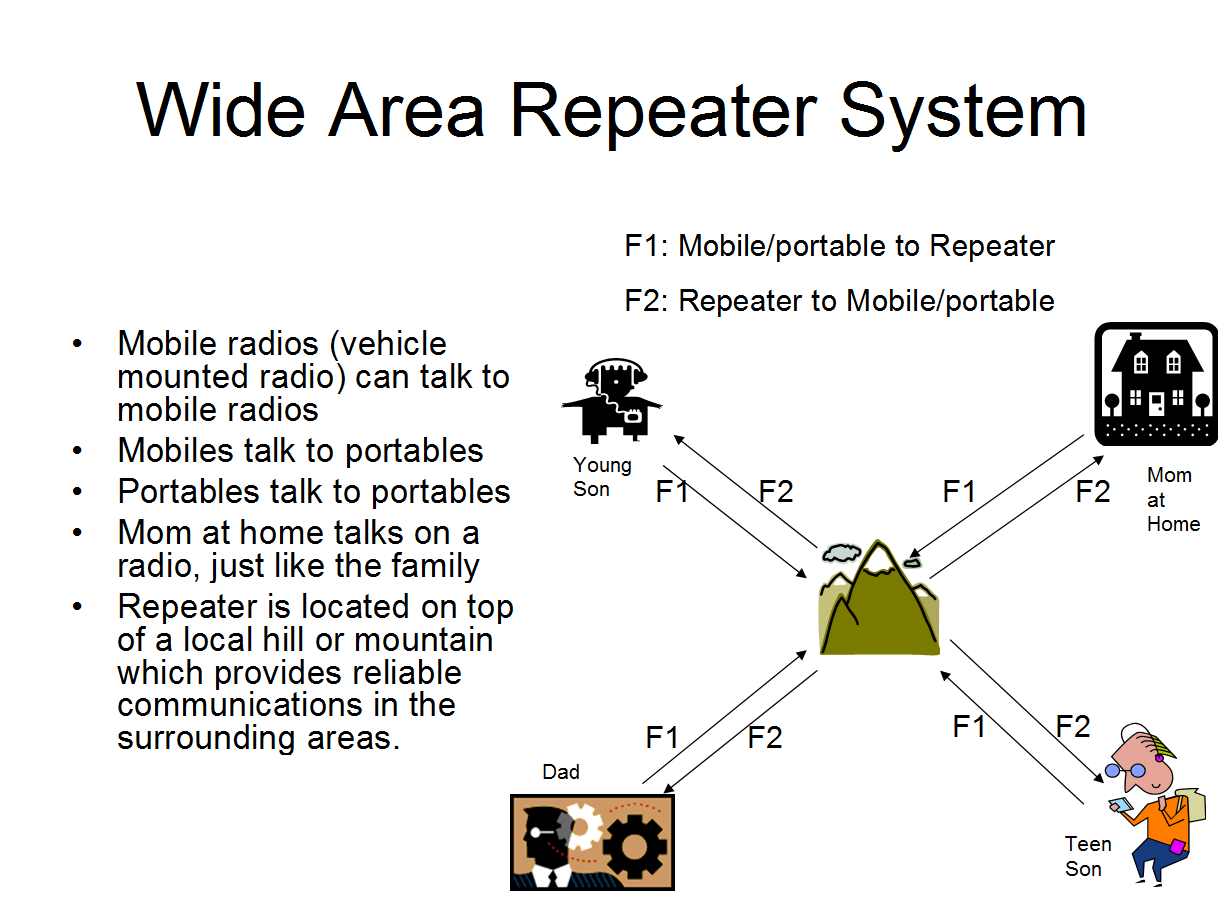
Relays – With simplex radios there can be situations where two stations can’t hear each other, but you can hear both. In this case you may be able to take the message (accurately) and resend it. This is not typically needed on repeater systems unless the other stations are on different frequencies.
Phonetic Alphabet – Most people have heard it, if only on TV. Few actually use it properly. This is used to make communications more precise. Sometimes a word may need to be spelled, or you may need to relay a model number or callsign. The problems is many letter sound similar. B,C,D,E,G,T or A and K. It helps to stick to a standard phonetic alphabet to avoid misunderstandings. Making it up as you go can cause confusion and some words don’t make good examples. Phone sounds like an F, but starts with P, which did you intend? Another common mistake is “as in”. Phonetically my callsign is King Edward 6 Tom Nora Mary (KE6TNM in APCO phonetics) While it may be helpful to tell the person on the other end you are sending phonetics, many people will start using “as in”. K as in King, E as in Edward, 6, T as in Tom, N as in Nora, M as in Mary, is a waste of air time and slows down writing the message waiting for the next letter.
Call signs – These identify a station, operator or location. Licensed operators are issued a formal callsign by the FCC. There are also uses for tactical calls (these can be made up), especially if the radio operator there may be changed. Then communications can consistently go to the same location such as “command post”, “medical”, “transportation” or “rover 1”. Names may work in a small group, but can get clumsy in larger groups.
Mic Fright – Talking to an unseen audience often intimidates people. You will make mistakes, with practice you get used to it.
Net Operations – for small groups an informal procedure is often sufficient. If there is enough traffic to start having collisions and organizational problems, it is helpful to have one station appointed as Net Control. Their job is to keep the traffic orderly, prioritize, cache information and make sure all messages reach their destination.