A defining characteristic of emergencies is their unpredictability. However thoroughly an organization prepares, a crisis rarely unfolds exactly as anticipated. Systems that appear reliable under normal conditions can fail without warning, communication channels may become overloaded or fragmented, and the flow of accurate information can quickly break down. In such moments, confusion often prevails among individuals who are under pressure, frightened, injured, separated from others, or uncertain about what action to take next. Even people who have been trained for emergencies may find themselves forced to make decisions with incomplete information, limited time, and rapidly changing circumstances. Plans and resources, no matter how carefully prepared, procured, or rehearsed, may prove inadequate, unavailable, or unsuitable when the crisis actually unfolds. A response plan may assume that roads remain accessible, that key personnel can be reached, that power and internet service will continue, or that supplies will be delivered on schedule. Yet in a real emergency, any of these assumptions can collapse. Equipment may be damaged, personnel may be overwhelmed, and coordination between agencies may become difficult precisely when it is most needed. What looks sufficient on paper can quickly become impractical in the field. I have witnessed first responders and government agencies encounter scenarios that they were unable to resolve effectively because these situations fell outside the scope of their standard procedures, training, and prior experience. In some cases, responders were not lacking commitment or courage; rather, they were confronted with conditions that did not match the models they had prepared for. These experiences demonstrate that emergency readiness must go beyond rigid checklists and predefined protocols. It requires flexibility, sound judgment, improvisation, strong communication, and the ability to adapt resources to unfamiliar circumstances. The most effective emergency response systems are those that recognize uncertainty as an unavoidable reality and prepare people not only to follow plans, but also to think critically when those plans no longer fit the situation.
There are steps that we can take to minimize the impact of the things that might occur:
Effective net control is a critical component of any emergency communications network. During major incidents, net control is typically managed from the Emergency Operations Center (EOC), while smaller events may be coordinated from the Command Post. Ideally, this function should be established away from the immediate incident area in a relatively quiet location that minimizes confusion and provides reliable communication access to all key operational sites.
One of the primary responsibilities of Net Control is to organize communications on the channel, prioritize message traffic, document essential information, and monitor the status of personnel in the field. In smaller operations, an informal net—where participants transmit as needed—may be sufficient. However, as traffic volume increases, so does the risk of overlapping transmissions, which can cause confusion and prevent critical messages from being heard. Establishing a controlled net allows higher volumes of communication to be managed effectively on a single channel. It helps ensure that calls are handled efficiently, messages are routed appropriately, and someone is always available to respond when needed.
Positioning net control at an elevated location, such as the upper floor of a sturdy building, a hilltop, or a purpose-built communications tower, can significantly improve radio coverage across an incident area. Elevation helps reduce obstructions caused by terrain, structures, vegetation, and other physical barriers, allowing signals to travel farther and more reliably. When feasible, using an antenna system with adequate height, proper grounding, and clear line-of-sight can greatly increase the likelihood that net control will be able to communicate with as many field units and support locations as possible. This improved coverage is especially important during large-scale incidents, severe weather events, wildland fires, search and rescue operations, evacuations, and other emergencies where responders may be spread across a wide geographic area.
A well-positioned net control station also helps reduce the impact of unexpected technical issues. If one repeater, radio channel, antenna, or power source fails, net control may be better able to adapt by switching frequencies, using an alternate communications plan, relaying messages through other stations, or coordinating the use of backup equipment. Whenever possible, communications teams should consider redundant power, spare radios, backup antennas, extra batteries, printed contact lists, and pre-established procedures for degraded or failed communications. Planning for these contingencies before an incident occurs can help maintain continuity of operations and prevent critical information from being delayed or lost.
Critical communication points may extend well beyond the Emergency Operations Center (EOC) and the Command Post. In addition to these primary coordination locations, communications may be needed with staging areas, planning teams, logistics sections, public works departments, transportation units, municipal or county agencies, evacuation centers, shelters, volunteer organizations, public information officers, the incident commander, fire personnel, law enforcement officers, emergency medical services, utility providers, and other key stakeholders involved in incident management. Depending on the size and complexity of the event, communications may also include school districts, hospitals, animal services, mutual aid partners, state agencies, amateur radio operators, and community organizations supporting response and recovery efforts.
Maintaining reliable communication among these groups supports timely decision-making, resource tracking, responder safety, and accurate public information. For example, staging areas must be able to report available resources, logistics personnel need to coordinate supplies and equipment, evacuation centers may need to request transportation or medical support, and public information officers must receive verified updates before releasing information to the public. Clear communications procedures help ensure that messages are routed to the correct person or section, recorded when necessary, and acted upon without unnecessary duplication or confusion.
FEMA protocols and the National Incident Management System (NIMS) recommend colocating representatives from essential agencies whenever possible to support efficient information sharing, message coordination, and overall incident response. Colocation can improve situational awareness by allowing agency representatives to exchange information directly, resolve questions quickly, and coordinate priorities in real time. When physical colocation is not possible, agencies should establish reliable alternate methods such as radio nets, conference calls, virtual coordination platforms, shared incident logs, or scheduled situation briefings. These practices support unity of effort and help ensure that response activities remain coordinated across jurisdictions and disciplines.
For additional guidance on incident management, communications coordination, and NIMS-related principles, refer to FEMA’s training resources:
https://training.fema.gov/nims/
In system design, redundancy and resilience should be core priorities. Establishing multiple communication pathways helps maintain availability even when individual systems fail. These pathways may include phones, internet connections, radios, cellular networks, and satellite links. Each option should be evaluated carefully for its strengths, limitations, and potential points of failure.
Backup systems should rely on diverse technologies whenever possible. For example, organizations may maintain both wireless and landline services, or combine radio communication with cellular connectivity. Satellite connections can also provide valuable redundancy, but they do not guarantee uninterrupted access, as coverage may be unavailable at certain times or in certain locations. Similarly, cellular networks can become overloaded and may have limited backup power, while radios may be affected by interference from other users on the same frequency. Because no communication system is completely fail-safe, reliable design depends on multiple, diverse layers of redundancy.
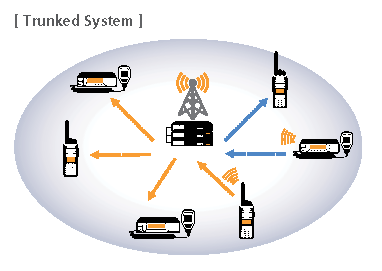
An “All Call” is a crucial feature in trunking systems. It allows authorized users to broadcast messages to all radios, or designated groups of radios, regardless of their current channel. However, it’s important to note that radios operating in simplex mode or on a different system will not receive All Call messages and must be contacted separately. The ability to transmit and all call is usually limited to certain radios, but it is useful to have it received by all the radios in it’s it’s chain, or the sender’s span of control.
When an incident initially occurs, chaos tends to be at its peak. Effective management begins with restoring order: communications are streamlined, the appropriate personnel and resources are mobilized, and a clear organizational structure is established. As these measures take effect, the chaos steadily subsides and, ultimately, order is reestablished by the conclusion of the incident.
Messages can be directed in various ways. Some may be intended for the entire system, while others are meant for specific groups. Therefore, it is beneficial to have both system-wide communication capabilities and dedicated channels for individual groups. For example, a team working on a particular task may need to communicate privately among themselves without involving others.
When implementing compartmentalization, careful attention must be given to the routing points. At the intersection between the wide area channel and the local channel, it is advisable to have a dedicated base radio for each channel involved. This ensures continuity of communication if equipment fails or if someone is operating on the wrong channel, thereby reducing the risk of lost calls. It’s important to consider that any individual might need to step away or could unintentionally be tuned to an incorrect channel. Additionally, portable radios rely on batteries and have a more limited range compared to base radios. In the event of a failure, a base radio equipped with a rooftop antenna can cover a larger area and maintain communication, effectively compensating for the limitations of portable units.
Channel changes are more problematic than most people realize. Switching channels in the midst of an operation often results in losing up to 50% of operators—some will successfully switch to the new channel, others will remain on the old one, and some may end up on an entirely different channel. To minimize the issues caused by a channel change:
The “All Call feature can be useful in locating users that ended up on an unknown channel.
Numerous factors can disrupt communication and lead to confusion. Interruptions in the communication channel are one such issue; however, problems can also arise from multipath transmission, which may result in the arrival of outdated, conflicting, or corrupted messages. Although there are established procedures to mitigate these risks—and they may seem like common sense—it is remarkable how frequently individuals struggle to follow them, especially when under pressure.