By: Mark Abrams
It was a hot summer day in Los Angeles during July 2021 when we headed to the small town of Shoshone to install another site on our digital network. For those who are not familiar with the town, it is about 60 miles north of Baker (the gateway to Death Valley) and about 50 miles south of the main portion of Death Valley. The heat continued to increase as we headed east towards the Cajon Pass that would take us into the desert.
On Wednesday morning, I left the house at 5:15AM and arrived at the shop by 5:45AM where I took care of a few last minute issues in the office. I left the office by 6:15AM and headed to the 605 Freeway and proceeded north towards the Foothill (210) Freeway. Traffic was still not very heavy, but it was building by the minute. I then took the 210 east towards Interstate 15 which heads to Las Vegas and found traffic to be causing some slowing which prevented traveling at full speed, but nothing that caused a major delay. So as I headed north up the 15 Freeway, I was able to accelerate to the increased 70MPH speed plus the normal fudge factor that most people use to travel another 5MPH above the speed limit. At this speed, I was able to make good time heading towards Shoshone. I climbed up the Cajon Pass on Interstate 15 and eventually arrived at the high desert in the Adelanto area. This area of the desert is fairly developed and many people live there and work in the Inland Empire, Orange County or Los Angeles counties. I wanted to get to Lenwood which was another 30 minutes ahead before I made a pit stop to have breakfast and use the restroom. As I pulled off the freeway in Lenwood, I selected Tommy’s Original to have a breakfast sandwich.
After about a 15 minute stay over to eat a breakfast sandwich and purchase chili burgers for lunch for the entire crew, I proceeded to get back on Interstate 15 heading towards Las Vegas. It was another hour drive to reach Baker, the gateway to Death Valley and the home of the world’s tallest thermometer which is an iconic landmark on the way to Las Vegas. Stopping briefly at Baker to get a cold drink, I looked at the thermometer which indicated that it was 110 degrees at 9 o’clock in the morning. Now that I was off the freeway, it was surface streets for the balance of the 60 mile trip from Baker to Shoshone over a 2 lane road. The road was sparsely used during this time of year due to the heat in the desert. The bulk of the tourist traffic occurs in the months February through April with a significant amount of traffic in January, May, October and November. I arrived a little after 10AM in Shoshone with a posted population of 31 people. I think that the sign was fairly accurate as the town consisted of just a few buildings which included the local gas station where the price of gasoline was over $5 per gallon, a Caltrans station, the Inyo County road department, a church, the Crowbar Restaurant & Saloon plus the Inyo County Sheriff station. There is a small contingent of houses and a very small Motel with about 6 rooms.
So now we are all here as the others in the crew arrived prior to my arrival. They were strategically positioning their vehicles and unloading the equipment for the job. It was only 102 degrees as it was overcast at this time, so at the start of the job we were optimistic that we might survive the job before collapsing from dehydration and exhaustion.
| We started the job by unloading the radio equipment and moving it into the building because it was in our way to get to other tools and supplies in the vehicle. The equipment cabinet was black which meant that we needed to get this done expeditiously so that the equipment did not get too hot to handle. So all four of us loaded the equipment onto the dolly and wheeled the equipment to the door of the building. The equipment cabinet was taller than the front door, so we had to be a bit creative to get the equipment through the door and inside the building by leaning the cabinet forward into the doorway with two of us inside to handle the top of the cabinet and two of us outside to handle the base of the cabinet. The cabinet weighed about 300 pounds with the equipment already wired and assembled inside, not including the 500 pounds of batteries that had to be installed once the cabinet was in place. The doorway was barely wider than the cabinet which made getting the equipment inside difficult since we did not want to damage the doorway. We got the equipment inside the building and had to move it through a second doorway that was also too small for the equipment, so we had to repeat the process to get through the second doorway. We placed the equipment cabinet into its location, but the floor was very uneven, so we needed to come up with a plan to level the floor. | While we were working, we were being attacked by the Shoshone horse fly which looked more like a nuclear dive bomber than a bug. It was black with a body about 1” long and about 1/4” wide with a squared off head. They would land on your clothing and bite through the shirt or pants. It was fairly common to have one or two of them on your body or clothes at any time during our work. |
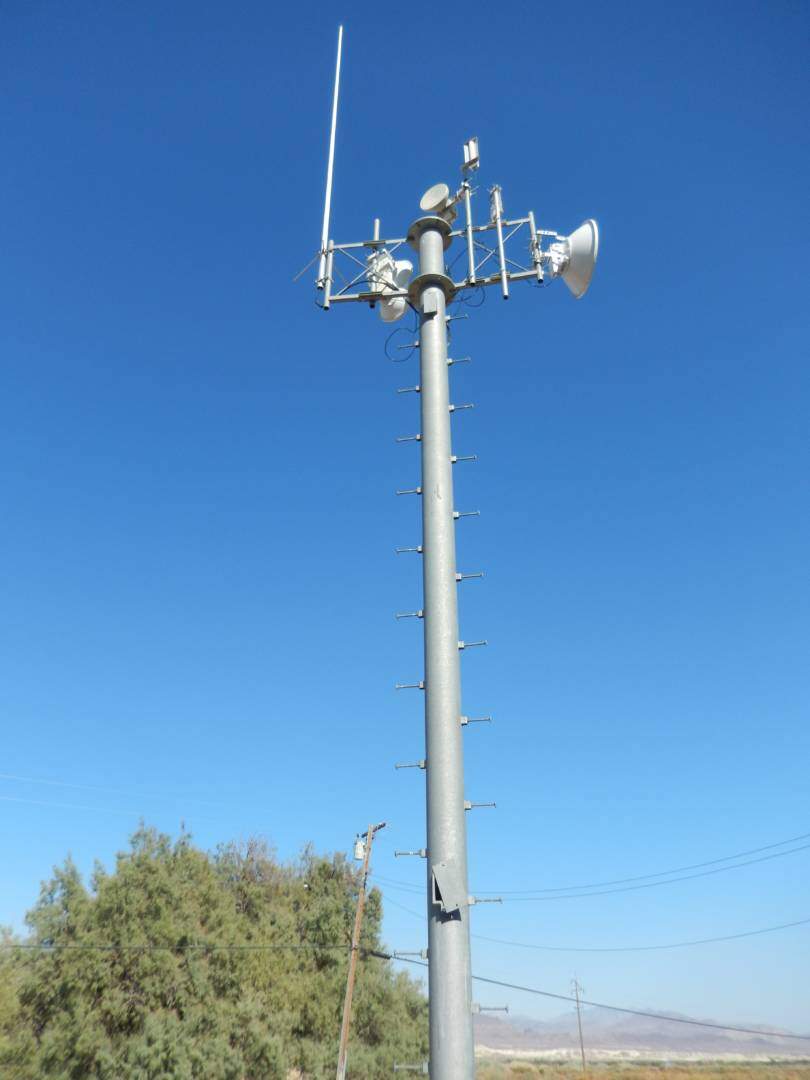
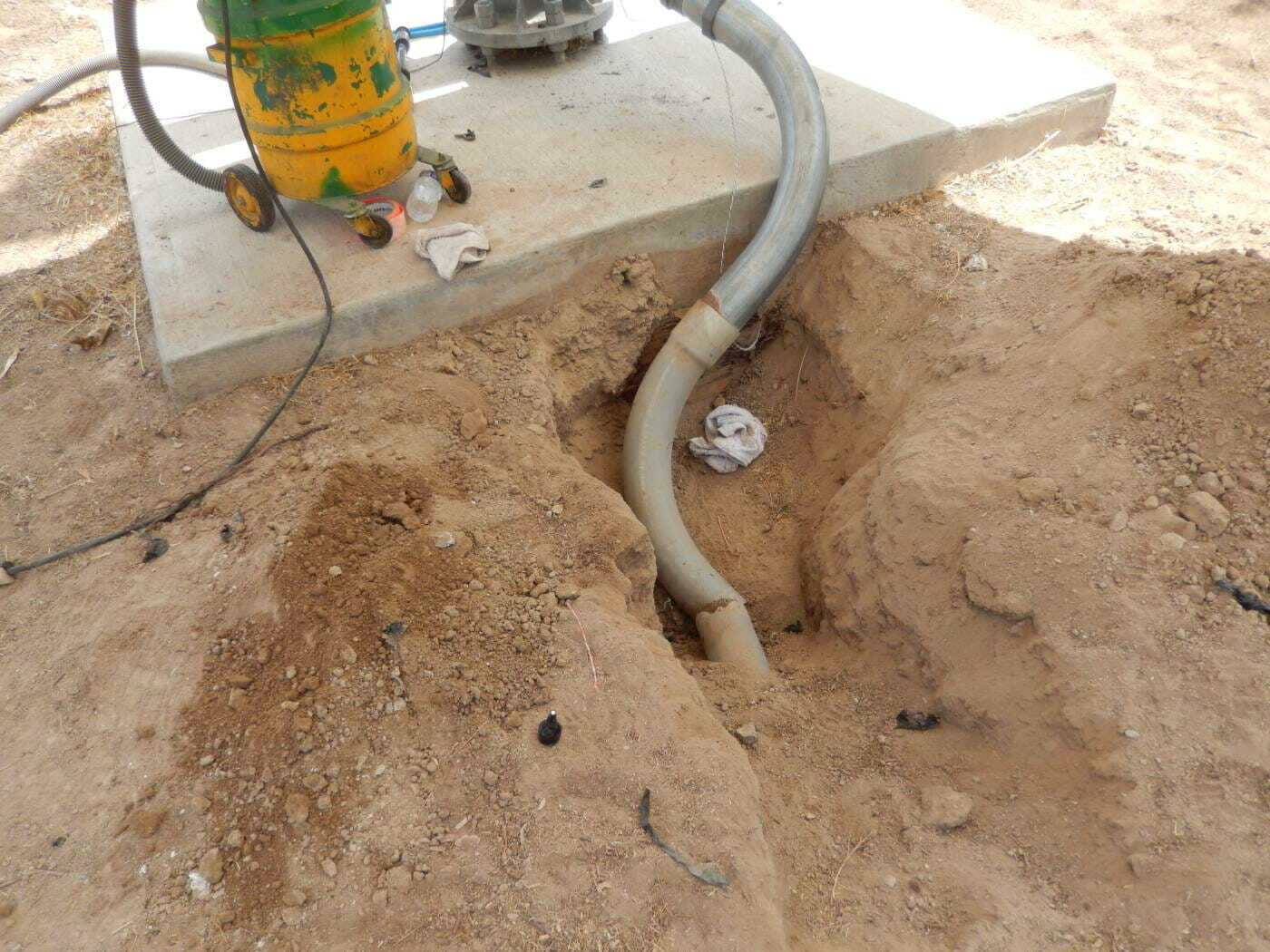
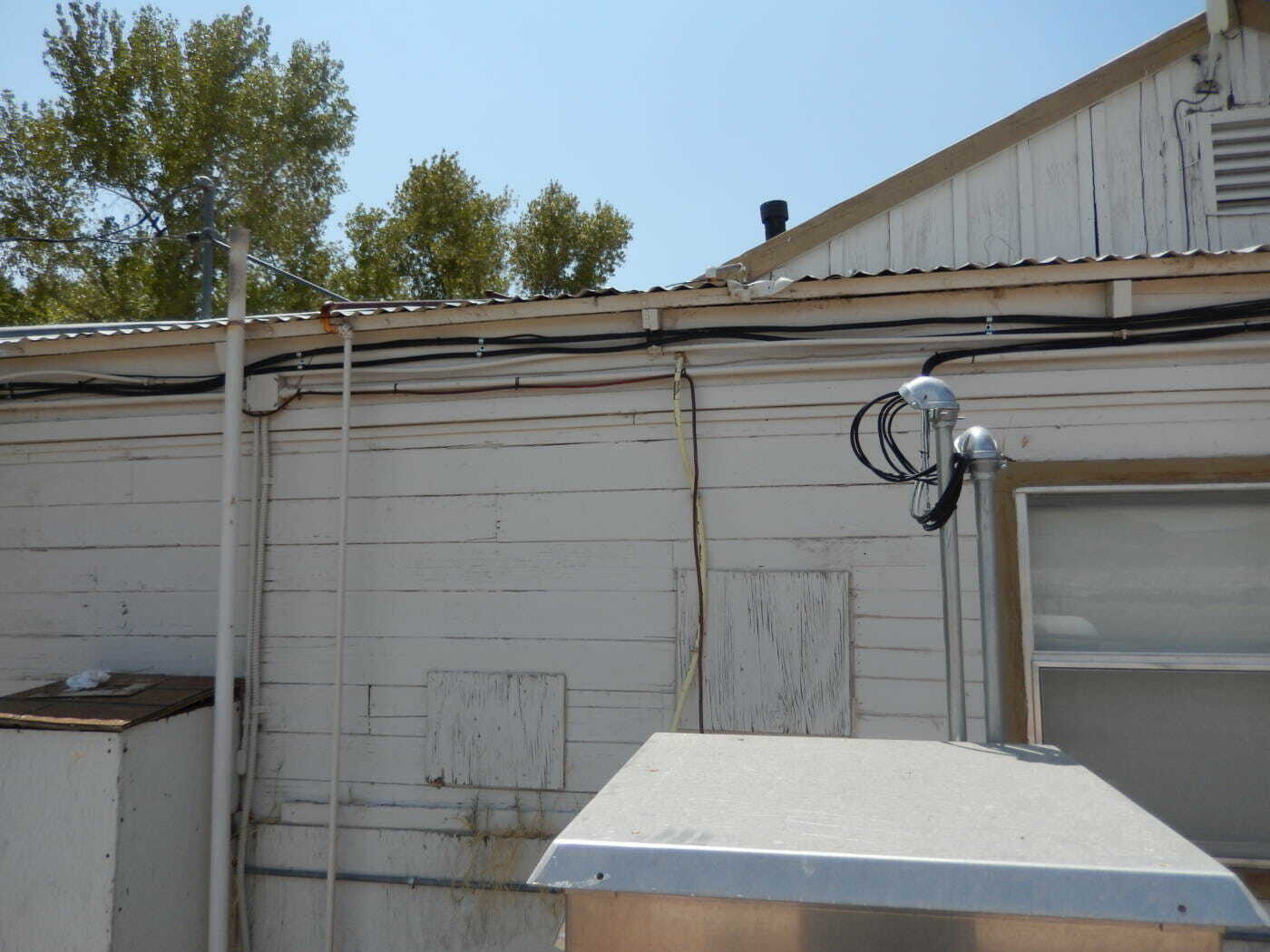
Now that the radio equipment was inside the building, we started to run the cables from the building to the 30 foot tall monopole where the antennas would be located. The pathway was a 4” underground conduit that already had several other cables in the conduit. The conduit was about 70 feet long with a 90 degree sweep from horizontal to vertical at each end of the conduit. At the building end, the conduit rose about 6 feet above ground and then turned horizontal for a short distance. At the monopole end, the conduit came out of the ground and immediately turned horizontal again and met with the monopole where the cables were pulled inside the monopole to the top where the antennas were located. This presented us with a difficult situation of requiring us to be able to pull the cables around back-to-back 90 degree sweeps and then entering the monopole where a 90 degree right turn was necessary to go up the inside of the pole. We started by attempting to feed the fish tape through the conduit. After multiple tries to get the fish tape through from both sides, we tried the rodder which is a stiffer version of a fish tape. Both tools got stuck at the same place from both directions which convinced us that there was a blockage in the conduit. So now we got out the vacuum and inserted the hose into the conduit to attempt to vacuum the dirt out of the conduit. We managed to get quite a bit of dirt out of the conduit, but there was considerably more that was still blocking the conduit. At this point, we decided that we had to dig up the conduit and find out what was blocking the conduit.
Now it was 4PM which was time to clean up for the day. We had started at 6AM, so we had already worked a 10 hour day not including the time to get up and get ready to leave the house. We rolled up the cables and tied them down for the night so that hopefully nothing would happen to them during the night. We packed up our tools and put away all the materials in our vehicles or in the building. The guys then drove about 35 miles to Pahrump to the nearest hotel (other than the one in Shoshone) where they checked into the room and began the process of unwinding for the day. I stayed and talked with locals about the new installation and how it was going to benefit them, discussed the new programming features that would be implemented and other features that they might want to have programmed into their radios. An hour and a half later, I left Shoshone and headed to the hotel to meet up with the others and have dinner with them.
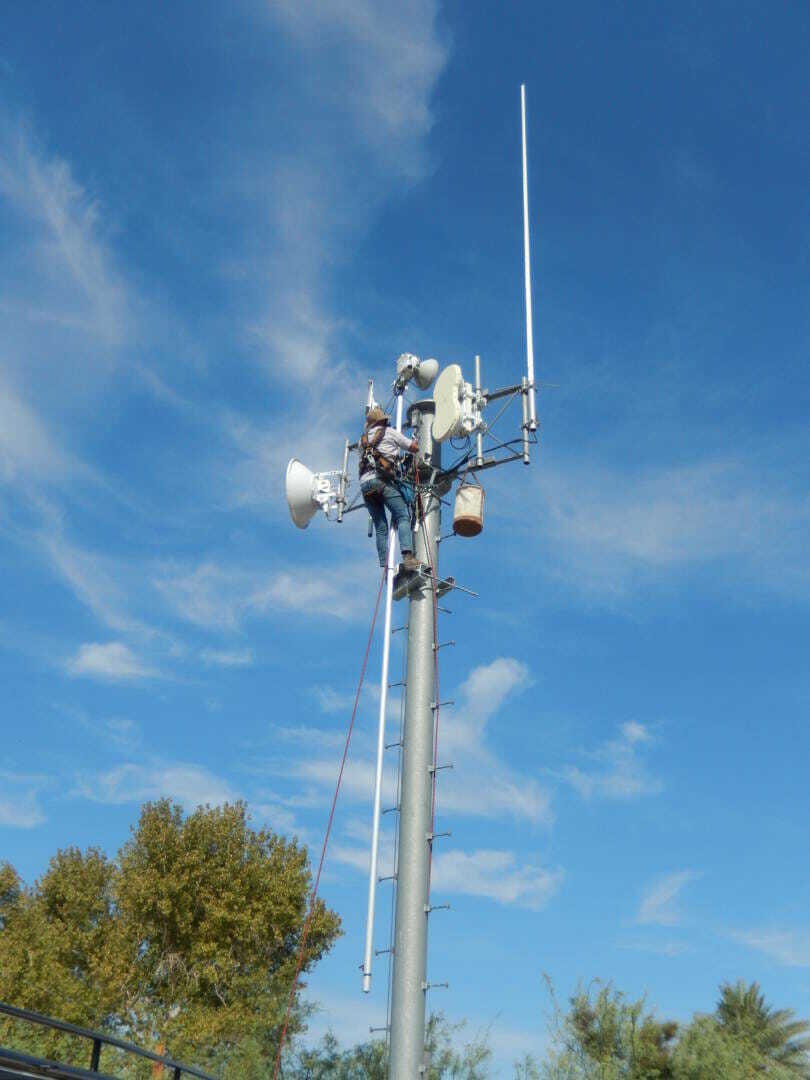
The next morning we had a wake up call for 4AM. The plan was to leave the hotel at 5AM so that we could be on site working by 6AM when the sun would be coming out for the day. The previous day had been overcast much of the day, but we did not know what was in store for us. The plan was to get the antennas installed on the monopole which required a significant amount of work. All the space on the monopole for antennas was occupied by other radio systems including 3 microwave dishes which brought the internet into town and distributed the signal around town. We could not disturb the existing systems while we worked on the monopole so we had planned on building out some new locations to mount the antennas.
The first step was to goop up with sun block because the skies were mostly clear and it was going to be warmer than yesterday. We were fortunate yesterday with a mostly overcast sky which kept the temperature “low” around 95-102 degrees depending upon the time of the day. Today the sky was mostly clear so we expected the temperature to be another 10-15 degrees warmer. This meant that the metal of the antenna structure would become too hot to handle with bare hands, and it would be possible to receive a nasty burn by touching the monopole for only a moment which is almost impossible to avoid while working on the structure.
Before starting the antenna installation, we had to assemble the clamps and get all the hardware ready to be raised up the monopole. The clamps that grab and hold onto the 11 inch diameter monopole and allow us to mount a vertical 2” diameter support pipe that is offset from the monopole far enough to allow the pipe to extend beyond the flanges on the monopole are made from heavy gauge steel and are hot dipped galvanized which sometimes have problems when the galvanized coating is too thick on the threaded rod. Of course, this was one of those times and we could not get the nuts to thread onto the threaded rod since the starting threads on the rod would not allow the nuts to get started. So we had to thread the nuts onto the far end of the 2 foot threaded rod and thread the nut down the rod until we reached the other end. Considering the fact that there were many sections of the rod that had too much galvanizing, it took over 15 minutes just to thread one nut onto the threaded rod. We needed to put a total of 3 nuts on each threaded rod, so this process took awhile to accomplish. The antennas needed to be assembled and the jumper cables needed to be installed. One jumper cable was 19 feet long and the other was 3 feet long. We had the 3 foot jumper, but we had to make the 19 foot jumper which takes more time. We then had to assemble the clamps that would hold the two antennas to the new mast we were installing which fortunately did not have a problem with the galvanized coating being too thick.
The next step was to prepare the cables for being raised up the inside of the monopole which required several processes. First we had to install the mating connectors on the end of the two antenna cables. Secondly, we had to create enough flexibility for bending the cables by removing the final 3 feet of the conduit so that we could properly bend the cable that had traveled
Off to the town of Tecopa, I went over to the fire department that was located in Tecopa Hot Springs. I pulled into the yard and was immediately met by the fire chief who was outside near the gate expecting me to arrive. He directed me to the first vehicle to update with newer programming. The vehicle was sitting in the hot sun as they did not have an inside area or any kind of shade for the parked vehicles. It was almost 110 degrees outside and considerably warmer inside the cab of the vehicle where I had to plug into the radio to dump the new programming into the unit. I had the computer ready with the program running and the customer file already loaded. I wanted to spend the minimum amount of time in the vehicle due to the heat and the uncomfortable working environment where I had no place to set down my laptop computer and had to bend into several uncomfortable positions for my injured shoulder to accomplish the task. The cab of several of these vehicles were high off the ground which required climbing up steps and grabbing climbing handles, door knobs and seats that were too hot to touch without receiving a nasty burn. I tried to program the radio, but it kept coming back with the error message of incorrect password. I tried multiple times with the same result so I wanted to figure out how to resolve the problem in a more comfortable environment. I eventually left the vehicle after spending about 20 minutes inside the cab of the vehicle and went into the office where they had the base stations which I could use to troubleshoot the password problem.
I called into the office to get the correct password. I was told that it was one of two different similar passwords. I could not get either of the two passwords to work, so I tried multiple variations of the passwords; all of which failed to provide me with access to program the radios. I went out to my car and grabbed the high speed programming cable on the assumption that the problem had something to do with the cable that I was using. I tried new communication port settings until I got the port to work and tried different positions on the program cable switch until the cable started to respond. I then tried the different passwords until I was finally able to access the programming function of the radio. After successfully programming the first base station, I proceeded with the next two base stations and found that one of them was missing the power cable that attaches to the power supply that supplies power to the radio. So I had to move power cables around to facilitate the programming the base station. (I have tried hundreds of times to program radios that did not have power applied, but it never works. You would think that I would learn the lesson well enough to stop trying such a fruitless endeavor, but in the heat of the moment, I continue to overlook the necessity to have power applied to successfully program the radio.) Now that the base stations were programmed, I went back out to the vehicles and updated their programming one vehicle (and radio) at a time. There were 9 portable radios for me to program, so I took them with me to reprogram them at the hotel and would return them the next day.
Now it was time for me to head back to the hotel to meet up with the guys who were busy relaxing, swimming and drinking beer. The heat in this area is something that we normally do not experience as the Los Angeles area rarely gets this hot. So after I finished reprogrammed the 9 portable radios, relaxed and cooled down, we all went off to dinner. We had a great meal and returned to the hotel around 9PM. I took care of emails and went to bed to be ready to get up at 5AM the next morning to finish the repeater site installation and take care of a few last issues for the customer.
It seemed like I just went to sleep when the 5AM wake up call arrived. It was now time to get up and prepare for the day which started with a shower to get all the sweat off the skin. I finished getting ready and then looked at my emails to see if there was anything that needed to be handled. After dealing with all the emails, I packed up the computer and vacated the room with my luggage, headed down the elevator and put the luggage in the vehicle. We then met in the lobby to have breakfast before heading to the job site. We had breakfast, checked out of the hotel and took off for the gas station to fill up with cheap gas before heading to the job site where we could have purchased the gas across the street from our job site for only an additional $1.25 per gallon beyond what we paid for the gas in Pahrump. If one is low on fuel, then the $5.60 gas is cheap compared to the problem of pushing the vehicle through the desert.
.Upon arrival at the job site, we were informed that the internet was down in the entire town since 10PM the previous night. This was a huge problem for us because we could not finish the job without the internet. We could not program the router and test the connection which meant that the site would be an island unto itself and not connected to the network. It also meant that we would have to return to complete the job and the job site is a 4.5 hour drive (one way) to come back to finish the job. Therefore it was important to us that the internet connection get fixed before we had to leave.
W
While this process was in progress, we noticed that out equipment at Ibex Pass which provided coverage into this area had gone off the air. We were convinced that there was a power outage at Ibex Pass tower site, so I decided that I needed to head over to the tower and see what could be done to get our equipment back on the air. We had the batteries with us that were meant for the site we were installing, but I felt that we should take them to the tower site in case we needed them to get our equipment back on the air. So I left the job site and headed south to Ibex Pass with Nick a few minutes behind me with the batteries. Upon arrival at the site, I grabbed the site keys and attempted to open the lock. I tried over and over again, but to no avail. I was almost ready to give up with the key to the lock and was considering cutting the lock off the gate when I spotted another gate. So I went over to the other gate and tried the key in this lock. Fortunately, the key fit this lock and I was able to gain entry to the compound.
I started by noting that the backup generator was running so I felt that it was imperative to open up the Generac power transfer switch. I measured the voltage from Edison which was 90 volts instead of 240 volts. When divided by 2 for the two different phases of the power line, it amounted to the 45 volts that I measured out of the outlets that I could reach. The voltage out of the generator was 240 volts and the transfer switch was energized with the proper voltage going into the cabinet, but the voltage reaching our equipment was only 45 volts. So the question at hand was “Why wasn’t the proper voltage reaching our equipment?” This would be an easy question to answer if we had access to all the other doors in the cabinet so that we could trace the wiring from the power panels inside the cabinet, but we did not have the access.
While this process was proceeding, another service vehicle from LV.Net arrived on the scene. LV.Net was the internet provider for the entire town of Shoshone, so it was clear to me that they were also down and this was the location of their problem. The technician parked his vehicle and proceeded to approach the compound. He entered the gate and before he could reach his equipment cabinet, I told him that the power was out and that his equipment probably was down for that reason. He opened his cabinet and acknowledged that I was correct. I asked him about his batteries and he indicated that they were completely drained. When I saw his battery bank, it was far smaller than our battery bank which would explain why the internet went down the night before while our equipment lasted until 9AM.
The technician from LV.Net was ready to give up and leave. He indicated that since the power was out and he did not have any way to power the equipment, he was going to leave without doing anything. We needed the internet to be working, so I told him NOT to leave and we were going to figure out how to get him power for his equipment. I worked with the LV.Net technician to identify the power connection for his equipment and determine where it entered the cabinet with the power connections. Unfortunately the 13th door which we believed would contain the power panels was locked and we did not have the key. So we used some trickery to get the door open and we found two power panels inside the door. One power panel was connected to the generator through the transfer switch and the other power panel was connected directly to Edison power. We opened the generator power panel and found that we had 120V/240V which was correct. We opened the Edison power panel and found that there was 45V/90V instead of the proper voltage. So now we had the problem well identified, but affecting a solution would take additional effort.
Now it was time to get power to the LV.Net equipment. We finished tracing the power connection from their equipment to the power panel and identified the proper circuit breaker that was powering their equipment. I removed the wire from the breaker and attached it to one of the circuits that was supposed to power the MRA equipment. I told the technician to check his equipment to see if it was now booting up and he indicated that he had power. His equipment needed a few minutes to finish the boot cycle and then their equipment was alive. We tried calling the balance of our crew at Shoshone to verify that the internet was back working, but we could not reach anyone at the time. So we now were looking at how to get the generator power to our equipment. The generator panel was clearly marked to indicate that MRA should be operating from the generator, but it was clear that whomever wired the power for us from the tower owner hooked the wrong circuits to the generator power. We tried to identify where the circuits that were on the generator was located within the cabinet. However, without the keys to the kingdom, we were unable to trace the circuits. So now the $64,000 question was how to get the generator power to our equipment.
We contemplated several methods of getting the power to our equipment. However, the clock was ticking with the system being off the air and the sun was beating on us making us overheated and sunburned. It was clear that we needed to solve the problem soon because we would not be able to stay out there much longer in the heat of the desert without supplies that we did not have with us. Our first idea was to cut off the plug from an extension cord and run it outside the cabinet from the power panel to our portion of the cabinet. This solution would work, but we would be sacrificing a perfectly good and expensive extension cord. However, that was not the controlling problem with the solution. If we used that solution, we would have to return to the site to restore the integrity of the cabinet once power was restored to the site to put everything back together correctly. Since this site was at least a 4 hour one way drive from our office and power could be restored at any unknown time in the future, we wanted a solution that did not require us to immediately drop what we were doing at the time and head back to Ibex Pass once Edison power was restored to the site. So we put on our thinking caps and came up with the idea of bypassing the existing wiring and putting new wires through the cabinet from the power panel to our equipment. However, there were two problems with that approach which includes (1) we were at the far end of the cabinet from the power panels and we did not have access to any of the cabinet doors between us and the power panels and (2) we needed some appropriate wire to make the connection. The first problem we solved by use of the fishing rods that Nick carries in his van. The second problem was solved by use of some two conductor zip cord that I was able to fish out of the back of my vehicle. So now we had the means to resolve the power problem and we proceeded to implement the plan. We taped the wire to the fish rod and passed it through the cabinet from the power panel to our equipment. We then disconnected the wires from the outlet from the power panel and attached the new wires that we just ran through the cabinet. Then we went to the other end of the cabinet where the power panels were located and routed the wire into the power panel. I attached the hot and neutral wires to the appropriate terminals which should have activated the power outlet for MRA. I then went to the outlet and verified the proper power at the outlet. At that time, I plugged in our power supply to power our equipment. We waited for the equipment to boot which took about 3 minutes. The system finished its boot cycle and came to life with the control channel transmitting continuously as it should. We then grabbed our radios and got them to log into the network. We called our companions at Shoshone to let them know that we had the system up and running. At that time, they verified that we not only had our equipment working, but the internet was fully functional. We hit the grand slam and now it was time for us to clean up, lock up and head back to Shoshone to assist with finishing the job.
While we were waiting for the internet connection to be resolved, we decided to go to lunch next door at the Crowbar Restaurant & Bar. It was the only restaurant in the town, but the food was good and so was the service. We relaxed while we ate and drank to our hearts content. It also accomplished killing time while we were waiting for LV.Net to get their act together and get our service provisioned. (Their office was completely unaware that we were the people responsible for getting their equipment back on the air.) When the meal was finished, the guys headed next door while I went to pay the bill with my credit card at which time the server commented that it was a good thing that I was here in the afternoon instead of earlier in the morning because the internet had been down and they could not take any credit cards at that time, but it was now working properly. I told her that I was the person who fixed the internet for the entire town and that I had just returned from the Ibex tower site where I took care of the power problem that was keeping the internet in town from working. She thanked me profusely for the good job I had done. I did not tell her that I fixed it so that we could finish our work installing the new equipment at the tower site, however I knew that the internet was out to the entire town and fixing my problem would fix the town’s problem.
When we were done with lunch, the IP service was “ready” for us from LV.Net but we still had a problem. Our IT person who was back at our office determined that they did not provide us with a sufficient number of IP addresses, so we had to get LV.Net to reconfigure the connection again to accommodate our need for IP addresses. Eventually, they had our service provisioned and now we had to reconfigure our router to match the IP information from the new addresses. So our IP specialists worked to get us up and running and eventually finished with his secret sauce and “voila”, we were on the air. We tested the connection multiple times and everything seemed to work properly, so we informed the customer to try his equipment. He could not get his radio to log into the site and access the system, yet our radios were operating properly. It became apparent to us that the programming for the customer’s radios in the network was incorrect. We needed to contact our network manager to fix the problem, but he was on vacation that day and was not in the office, so we called him on his cell phone. Fortunately, he was near a computer and was able to log into our network manager remotely and resolve the programming issue from where he was located at the time.
Now we were done for the day………….