
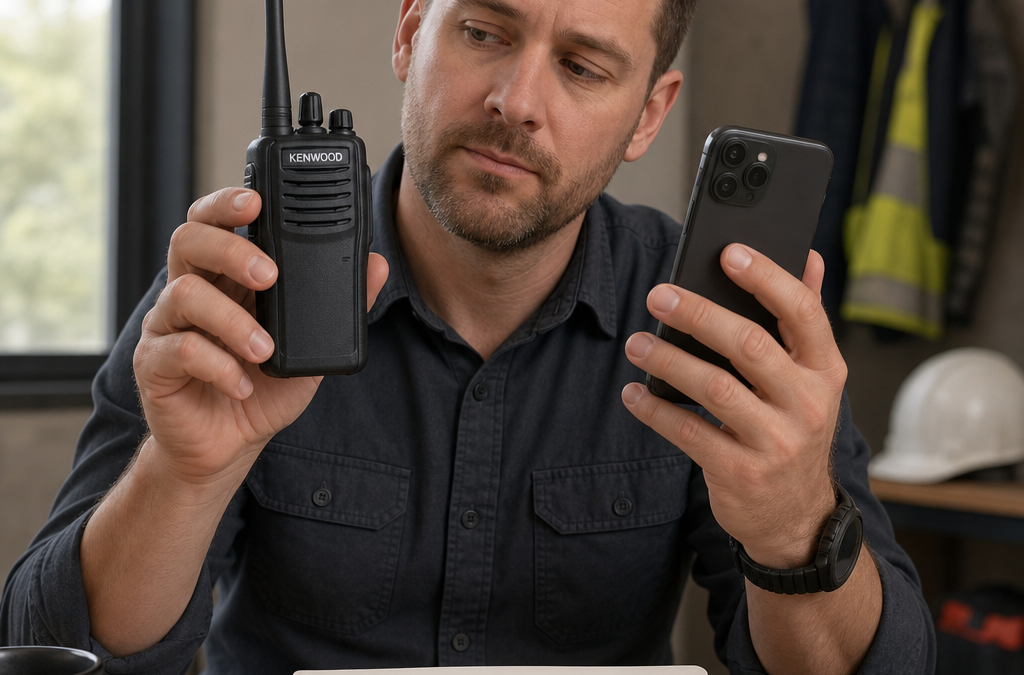
Effective team communication is critical to maintaining productivity, coordination, and safety across a wide range of industries. Whether employees are working on a construction site, managing logistics in a warehouse, coordinating events, responding to emergencies, or supporting daily operations in a large facility, the ability to share information quickly and clearly can directly influence performance and outcomes.
Strong communication helps reduce delays, prevent misunderstandings, improve workflow, and ensure that team members can respond promptly when conditions change.To keep employees connected, organizations commonly rely on either cell phones or two-way radios. Both options can support effective communication, but they serve different purposes and perform better in different environments.
Cell phones offer broad functionality, including voice calls, text messaging, email, mobile apps, GPS, and access to internet-based tools. They are especially useful for employees who need to communicate over long distances, share detailed information, or stay connected with clients, vendors, and office staff.
Two-way radios, on the other hand, are designed for instant, reliable, group-based communication. With the push of a button, workers can speak to an entire team without dialing numbers or waiting for a call to connect. This makes radios especially valuable in fast-paced or high-risk environments where immediate response is essential, such as security, manufacturing, transportation, hospitality, and public safety operations. They can also be more durable than standard mobile phones and may perform better in areas where cellular coverage is weak or unavailable.
By understanding the features, benefits, and limitations of each communication tool, teams can make a more informed decision and choose the solution that best fits their operational needs. Factors such as coverage area, cost, durability, ease of use, emergency functionality, battery life, and the need for one-to-one or group communication should all be considered. In many cases, the best solution may even involve using both cell phones and two-way radios together, allowing organizations to balance flexibility, speed, and reliability across their workforce.
Features and Capabilities of Cell Phones in Team Settings
Cell phones are highly versatile devices that offer a wide range of features beyond basic voice communication. In team settings, cell phones enable voice calls, text messaging, email, video conferencing, and access to a multitude of collaboration apps. This versatility allows teams to share detailed information, images, and documents in real time, making cell phones especially valuable for tasks that require comprehensive data exchange.
Modern smartphones are equipped with high-speed internet connectivity, GPS navigation, and robust app ecosystems. These features support not only communication but also coordination, tracking, and task management. For remote teams or those working in the field, the ability to use mapping tools, scheduling apps, and real-time updates significantly enhances productivity and responsiveness.
However, cell phones have certain limitations in team communication scenarios, especially when teams depend on fast, reliable, and focused exchanges of information. One of the main drawbacks is that cell phones rely on cellular networks, which may not always provide consistent or dependable coverage.
In remote areas, such as construction sites, rural service locations, outdoor event spaces, or emergency response zones, signal strength can be weak or unavailable. Similarly, in densely built environments with thick walls, underground levels, elevators, or large industrial facilities, cellular reception may be disrupted, making it difficult for team members to stay connected when communication is most important.
Call connection times can also be longer compared with dedicated communication tools, particularly when users must unlock their devices, find the right contact, place a call, and wait for the other person to answer. In fast-paced work situations, even a short delay can affect coordination, decision-making, and response time.
Cell phones may also be less efficient for group communication, since coordinating multiple people often requires conference calls, messaging apps, or repeated individual calls, which can slow down the flow of information.
Another limitation is the potential for distraction. Because cell phones are typically used for both personal and professional purposes, team members may receive non-work-related notifications, social media alerts, text messages, or app updates during critical tasks. These interruptions can reduce focus, increase the chance of mistakes, and make communication less disciplined. In environments where safety, accuracy, or quick action is essential, such distractions can be a significant concern.
In addition, security and privacy issues may arise when cell phones are used to share sensitive information. Personal devices may not always have strong passwords, encryption, secure messaging platforms, or updated software. If a phone is lost, stolen, or accessed by an unauthorized person, confidential business details, customer information, or operational plans could be exposed. For this reason, organizations often need clear policies, secure communication apps, and device management practices to reduce risks when cell phones are used for team communication.
Advantages of Two Way Radios for Group Communication
Two-way radios, commonly known as walkie-talkies, are designed to enable instant voice communication between users over short to medium distances. One of their primary advantages is push-to-talk functionality, which allows team members to connect immediately without dialing numbers or waiting for a call to connect. This speed and simplicity are especially valuable in time-sensitive environments, such as emergency response, construction sites, and event management.
Our two-way radios operate on dedicated radio frequencies, reducing reliance on phone-based communication networks such as cellular providers and internet-dependent systems. Since they do not require cell towers, Wi-Fi access points, or external service infrastructure, they provide a dependable communication solution in environments where other devices may struggle to maintain a reliable connection. This independence is especially valuable in remote locations, rural worksites, outdoor event venues, construction zones, warehouses, industrial facilities, and emergency response areas where cellular coverage may be weak, inconsistent, overloaded, or unavailable.
By using dedicated radio frequencies, these devices help teams stay connected when clear, immediate communication is essential. Whether coordinating daily operations, responding to unexpected situations, or managing personnel across a large area, two-way radios offer a practical and reliable way to share information quickly. Their push-to-talk functionality enables instant communication without dialing numbers, waiting for calls to connect, or relying on data service. This makes them particularly useful in fast-paced environments where delays can impact productivity, safety, or response times.
In addition, our two-way radios support group channels, allowing multiple users to receive and respond to the same message simultaneously. This feature simplifies coordination across large teams, departments, or work groups without the need to contact each person individually. Supervisors can issue instructions, share updates, or alert staff to changing conditions in real time, while team members can respond immediately when needed. As a result, two-way radios provide an efficient, organized, and cost-effective communication solution for businesses, events, public safety teams, and any operation that requires reliable group coordination.
Durability and extended battery life are additional strengths of two-way radios. Many models are designed to withstand harsh conditions, including exposure to dust, moisture, and impact. Their batteries also typically last much longer than those of smartphones, making them well suited for long shifts without the need for frequent recharging. Although two-way radios may lack the multimedia features of cell phones, their reliability makes them a preferred choice for many teams that depend on clear, direct communication.