
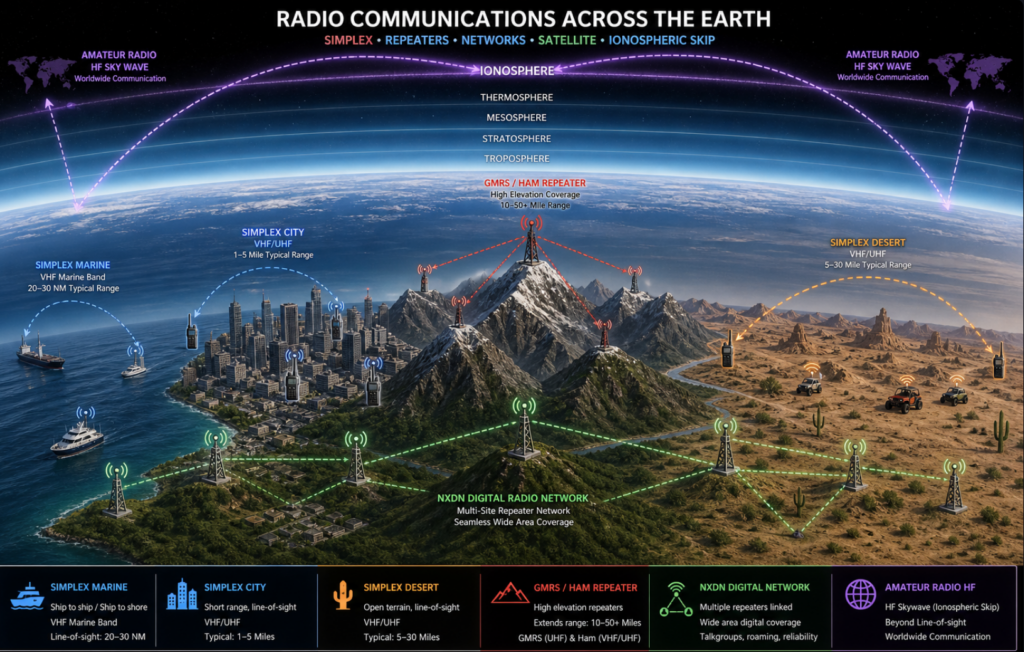
Recently, there have been many ads claiming that GMRS radios are better than CB radios. However, some users may be looking for something better than GMRS when it comes to overall performance and flexibility. These claims are often based on power, which is not necessarily accurate in free space. In other cases, they focus on the ability of a GMRS radio to access a single repeater—which is a valid advantage. But what could be even better? In fact, some modern radio networks deliver features that are simply better than GMRS for certain needs. What if you could use a network of repeaters? What if you could achieve greater range using a very narrow bandwidth—just 4 kHz—through a digital protocol? What if you didn’t have to worry about licensing, building infrastructure, or sharing channels? What if you could have your own exclusive channel with coverage extending hundreds of miles? Wouldn’t that be better?
GMRS is not the most advanced technology available; in several respects, alternatives are frankly better than GMRS.
| CB | GMRS | MRA NexEdge Network | |
| Range | Line of sight, typically a bit past the horizon. Does not go through hills. May occasionally skip to other states or countries depending on atmospheric conditions. Typically 2 to 20 miles | Line of Sight. Simplex (direct) use 2 to 20 miles. Using a repeater can extend 50 to 100 miles depending on the placement of the repeater. | California, Nevada and part of Arizona. |
| Antenna | 8.5 feet for a quarter wave. Shortened antennas are less efficient. | 6.3 inches for a quarter wave. Gain antennas may be 12.6 to 19 inches. | 6.3 inches for a quarter wave. Gain antennas may be 12.6 to 19 inches. |
| Power | 4 watts max | 50 watts max | 5 to 100 watts typical |
| Channels | 40 | 22 | Customizable |
| License | No | Yes | Handled by MRA |
| Frequency | 27MHz (HF) | 462MHz (UHF) | 450 to 512MHz (UHF and T band) |
| Modulation | AM, FM, SSB(12 watts) | FM | FM, NXDN Digital |
| Repeaters | No | Yes | Multiple Networked repeaters |
| Privacy | No | No | Yes, encryption capable |
| Cost | $100 to $300 typically | $100 to $500 typically | Depends on Features |

One detail many people do not expect is that a CB radio’s HF signal can sometimes travel farther in open space than signals from higher-frequency handheld radios. For outdoor users, CB can actually seem better than GMRS under specific conditions. CB operates around 27 MHz, within the HF range, and under the right conditions its lower frequency can propagate well over longer distances—especially across open ground, rural areas, or locations with fewer obstructions. CB signals may also benefit from certain atmospheric conditions, allowing them to travel much farther than usual through “skip.” However, skip is unpredictable and is not always useful for local communication. Even so, with a clear path and an efficient antenna, CB can often reach farther than people expect.
Inside buildings or dense urban areas, the situation can be quite different. UHF radios often have an advantage because their shorter wavelengths tend to perform better around walls, hallways, windows, vehicles, and other obstacles. While lower-frequency signals can travel well in open areas, they often require larger, more efficient antennas and may not perform as reliably inside structures. UHF radios with properly matched antennas are commonly used in warehouses, schools, hotels, shopping centers, and job sites because their signals can penetrate, reflect, or move through building materials in ways that help maintain communication. This does not mean UHF is always superior, but in many indoor environments it can be more dependable than CB.
For modulation, SSB, or single sideband, usually provides better range on CB than standard AM or FM. One reason is that SSB uses transmitter power more efficiently by concentrating more energy into the voice signal rather than wasting power on a carrier. CB SSB is also permitted up to 12 watts PEP, giving it a practical advantage over standard AM CB power levels. The tradeoff is that SSB can sound unusual if the radio is not tuned correctly. Voices may sound too high, too low, distorted, or robotic until the clarifier or fine-tuning control is adjusted. For users accustomed to simple AM or FM audio, SSB may take some practice, but it remains one of the best CB options when maximum range is the goal.
FM generally provides cleaner-sounding audio and often less background noise than AM, especially when the signal is strong. It can be more pleasant to listen to because weak static and crackling are reduced compared with AM. However, FM typically needs a stronger signal to sound good, and once the signal becomes too weak, it can drop off more abruptly. FM also uses more bandwidth than some narrower modes, which can make it less efficient on crowded channels and may reduce practical range compared with narrower or more power-efficient modes. As a result, FM may sound better at short to medium distances, but it is not always the best choice when trying to achieve the longest possible range.
NXDN is one of the narrowest commonly used digital voice modes. It is often associated with 6.25 kHz channel spacing and an occupied bandwidth of roughly 4 kHz. Because it is so narrow, NXDN can use available power efficiently and may improve the signal-to-noise ratio in many situations. Digital modes such as NXDN can also keep voice audio clear and consistent until the signal becomes too weak. However, once the signal drops below the usable threshold, the audio may break up or disappear rather than gradually becoming noisy like analog signals. This narrow bandwidth makes NXDN useful for efficient communication, especially where channel space is limited and reliable voice quality is important.
So, in summary, there are applications and features that can be viewed as better than GMRS, depending on your needs. Overall, the best choice depends heavily on the environment and the goal. CB, especially with SSB, can perform very well for longer open-area communication. UHF is often better inside buildings or dense urban settings. FM can provide cleaner audio over shorter to moderate distances, while NXDN offers efficient very narrowband digital performance where spectrum efficiency and consistent voice quality matter.